A practical guide for ages 4–8
Responding to harsh self-talk
When a child says “I’m stupid,” “I’m bad” or “I can’t do anything,” the words can sound like a verdict. Often, they are a fast way to express frustration, shame, disappointment or overwhelm.
Start by hearing the feeling. Then separate what happened from who the child is, and help them choose words that are accurate, believable, kind and useful.

Hear the message beneath the words
A painful sentence is not always a settled belief.
A child may reach for a global label when they do not yet have words for the size or shape of a hard moment. “I’m stupid” might mean “I’m embarrassed that I got this wrong.” “I’m the worst” might mean “I hurt someone and I feel ashamed.” “I can’t do anything” might mean “My body is overwhelmed and I cannot see the next step.”
The first job is connection, not correction. Listening seriously and without judgment helps create the safety needed for a child to keep talking. Once the feeling is understood, the adult can help make the sentence more precise.
Separate an event, a feeling and an identity.
“The blocks fell” describes an event. “I’m disappointed” names a feeling. “I’m a failure” turns one moment into an identity. Children do not need their disappointment erased. They need help keeping the disappointment from defining all of them.
Aim for believable language, not a bright slogan.
A child who feels defeated may reject “I’m amazing!” because it does not match their experience. A grounded sentence can hold both reality and possibility: “This part is hard, and I can try one smaller step.” Accurate words are easier to trust—and trusted words are easier to use.
Notice · Pause · Test · Choose
Help the words change shape.
These four moves turn an identity-sized judgment into information a child can work with. They can happen in one conversation or across several calm moments.
Notice
Reflect the feeling and the intensity before changing the sentence.
“That sounded like a really painful thought.”Pause
Slow the moment. A regulated body can examine a thought more flexibly.
“Let’s give that thought a little space.”Test
Find the part that is true and the part that has grown too large.
“What happened? What is the thought adding?”Choose
Build a next sentence that is accurate, believable, kind and useful.
“What words are true enough to come back?”Words for adults
Respond without starting a debate.
Contradicting the sentence immediately can make a child defend it. These responses make room for the feeling, narrow the claim and point toward the next useful step.
“Something happened that made you feel not-smart. Tell me which part felt hardest.”
This validates the experience without agreeing with the label.
“You made a choice that hurt someone. A choice is something we can understand, repair and change. It is not your whole identity.”
Accountability stays intact while shame is kept from swallowing the child.
“Right now, this feels too big. Which part could we make smaller?”
The next step matters more than proving the original sentence wrong.
“The true part is ____. The next helpful part is ____.”
Example: “The true part is that the first try did not work. The next helpful part is asking for a hint.”
Try it together
Replace the Echo
Use two speech bubbles, two index cards or two pieces of paper. A child can speak, point, dictate or draw. The goal is a truer sentence—not a cheerful performance.
- Catch the echo. Write or draw the harsh sentence exactly as it appeared: “I ruin everything.”
- Name what happened. Ask, “What happened right before those words showed up?”
- Find the true part. Try: “The paint spilled on this page.”
- Add the next helpful part. Try: “We can blot it, turn it into something or begin again.”
- Choose the returning words. Read both versions and let the child choose the one that is accurate, believable, kind and useful.
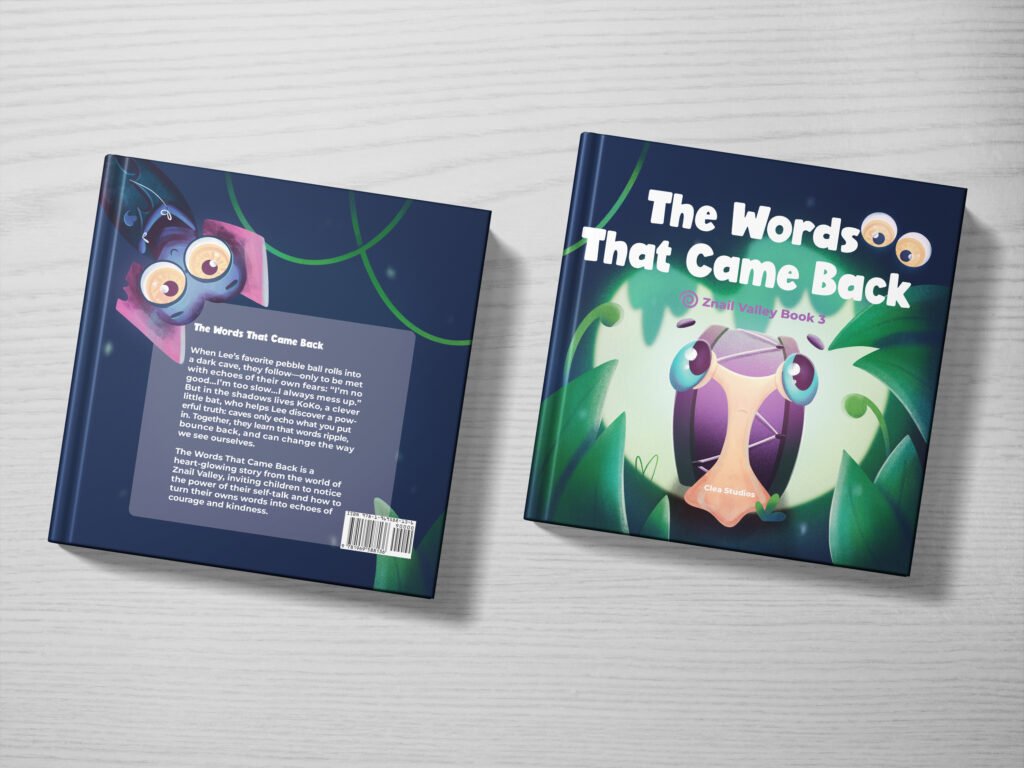 Znail Valley · Book 3
The Znail Valley connection
The Words That Came Back
After Lee loses their favorite pebble ball, harsh words follow them into a cave. The cave sends those words back as echoes. With KoKo’s help, Lee discovers that choosing different words does not mean pretending everything is fine. It means finding words that are accurate enough to trust and hopeful enough to help.
Why this story mechanism works
An echo makes an invisible inner process visible. Children can hear how repeated words gather force, then experiment with language that acknowledges the hard moment without turning it into a permanent identity.
Book details: Book 3 · Ages 4–8 · 32 pages · Published October 14, 2025 · Aria de Clea · Clea Studios.
Questions parents and educators ask
Harsh self-talk FAQ
Should an adult say, “That’s not true—you’re smart”?
The reassurance is loving, but an immediate contradiction can turn the conversation into an argument about whether the child’s judgment is correct. Start with the feeling and the specific event: “That problem left you feeling really stuck. Show me where it became hard.” Then help the child build a more accurate sentence.
Does using “yet” always help?
No. “Yet” can support a learnable skill when it feels honest: “You cannot tie that knot yet.” It may feel dismissive when a child is grieving, exhausted or dealing with something outside their control. Use language that fits the actual situation.
How can a child take responsibility without calling themself bad?
Keep identity and behavior separate: “You grabbed the toy. That hurt someone. What needs repair?” Specific accountability gives the child something they can act on; a global identity label does not.
What if the child refuses a kinder sentence?
Make it more believable and offer choices. “This is easy” may be too far away. “This is hard, and I can ask for one hint” may be close enough to use. The child may point, borrow the adult’s words or return to the activity later.
Is harsh self-talk a sign of low self-esteem?
It can be one sign, especially when it forms a frequent pattern with avoidance, withdrawal or giving up easily. One frustrated sentence does not establish a diagnosis. Look at frequency, intensity, duration and impact, and share concerns with a qualified professional.
Can this approach be used in a classroom?
Yes. Respond privately when possible, name the specific event, and avoid requiring a positive statement in front of peers. The frame “The true part is ____. The next helpful part is ____” can also become neutral classroom language for mistakes and revisions.
Sources and further reading
- American Academy of Pediatrics: Signs of Low Self-Esteem in Children & Teens
- American Academy of Pediatrics: Finding Mental Health Care for Your Child
- CASEL: What Is Social and Emotional Learning?
- Center on the Developing Child at Harvard University: Serve and Return
Educational information for parents and educators; individualized developmental or medical concerns should be discussed with an appropriate qualified professional.
Small bugs · Big ideas
Help a child find words that tell the truth without becoming a verdict.
Begin with one hard moment, one true detail and one next sentence the child can actually believe.