The Words That Came Back
When Lee loses their favorite pebble ball, one mistake turns into a cave full of harsh echoes. With help from KoKo—the bat who understands echoes better than anyone—Lee discovers that new words can make room for a new next step.
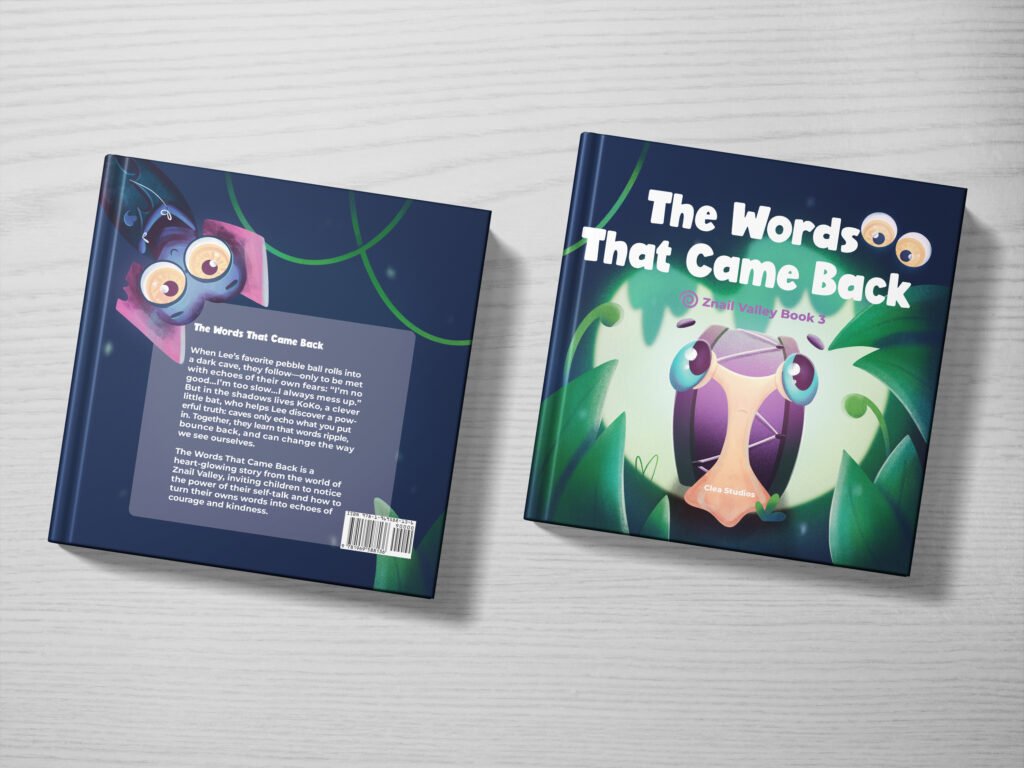
The Words That Came Back
A lost pebble ball sends Lee toward a cave—and starts an echo they did not expect. Here are the first few story spreads before Lee’s words begin coming back.


The story
A mistake is something that happened. It is not everything you are.
Lee’s favorite pebble ball rushes into a dark cave. As Lee follows it, worried words slip out: “I’m too slow. I always mess up.” The cave sends every word back—only louder.
Then KoKo swoops in. With thick glasses, enormous eyes, and an ear for every echo, KoKo helps Lee test what happens when they speak with more accuracy, possibility, and care. The cave changes as the words change.
“Caves only give back what you put in.”
What children recognize
“I made a mistake, so maybe I’m bad at everything.”
Children often turn one hard moment into a sweeping conclusion: always, never, nobody, everything. Those words can feel true because the feeling underneath them is real.
The story does not ask Lee to pretend the pebble ball was never lost. It separates the event from Lee’s identity—and gives children a concrete experiment: listen to the words, check whether they are the whole truth, and try words that help with what comes next.
KoKo’s echo check
What can a child do when harsh words come back?
The goal is not perfect positivity. It is language that is kinder, more accurate, and more useful.
Hear the echo
Notice the exact words. Naming the thought creates a little space around it.
Check the big words
Listen for always, never, everything, and nobody. Are they the whole story?
Name what happened
“I lost my ball” is an event. “I ruin everything” turns an event into an identity.
Try truer words
“This is hard,” “I made a mistake,” or “I can try one next thing” can all be honest.
Find the next step
Helpful self-talk points toward an action: pause, ask, look, practice, repair, or begin again.
Notice what changes
Words do not erase the problem. They can change what feels possible inside it.
Read-aloud prompts
Let children investigate the echoes.
Children can answer aloud, point to the art, repeat an echo, draw, act it out, or keep listening.
What can happen inside us after we make a mistake?
Which of Lee’s words describe what happened? Which words make the mistake feel bigger?
What could Lee say that is both kind and true—and helps them take a next step?
For parents, teachers, and librarians
Meet the feeling before changing the sentence.
When a child says “I’m terrible at everything,” the useful opening is connection. Once the child feels heard, the words can be examined together.
Start with what is true
“You’re really disappointed. You worked hard, and that did not go the way you wanted.”
Make the thought visible
“The thought saying ‘I always mess up’ is very loud right now. Should we check what it is echoing?”
Aim for believable language
Try “I don’t know how yet” or “One part went wrong” before a sentence the child cannot genuinely accept.
Pair words with action
Ask, “What words would help with the next tiny step?” Then practice the words while taking that step.
SEL connection: The story supports self-awareness and self-management through noticing internal language, distinguishing thoughts from facts, and choosing language that supports persistence. This is an alignment statement, not a claim of independently validated outcomes.
Book details
The Words That Came Back
| Series | Znail Valley, Book 3 |
|---|---|
| Written by | Aria de Clea |
| Publisher | Weeping Starlight Press |
| Publication date | October 14, 2025 |
| Length | 32 pages |
| Hardcover ISBN | 978-1-969588-13-6 |
| eBook ISBN | 978-1-969588-15-0 |
Questions grown-ups ask
About the book
What is The Words That Came Back about?
After Lee loses their favorite pebble ball in a rushing stream, they follow it into a cave where harsh words echo back louder. KoKo, a gentle bat and echo expert, helps Lee discover how more accurate and hopeful words can change what happens next.
What age is The Words That Came Back for?
It is a picture-book read-aloud for ages 4–8 and works well at home, in pre-K–2 classrooms, counseling settings, and library storytimes.
Does the book teach children to replace every negative thought with a positive one?
No. The story supports words that are believable, kind, and useful. “This is hard” can be more helpful—and more honest—than pretending everything is easy.
What social-emotional skills does the story support?
It supports conversations about self-awareness, self-talk, resilience, growth mindset, and separating a mistake from identity. These are alignment statements rather than claims of independently validated outcomes.
Who is KoKo?
KoKo is Znail Valley’s gentle, sharp-eared bat and resident echo specialist. In this book, KoKo helps Lee listen differently to the words that fill the cave.
Is The Words That Came Back part of a series?
Yes. It is Book 3 in the Znail Valley picture-book series and can also be read as a standalone story.
Change the words. Change what feels possible.
Follow Lee and KoKo into the cave where every word comes back—and every new word can light a way forward.