A practical listening guide for ages 4–8
Listening carefully and valuing every voice
Children hear sounds all day. Careful listening begins when they pause before deciding what a sound is, notice its details and stay curious about the voice behind it.
Help a child listen without rushing to guess: pause, describe what was actually heard, investigate with curiosity and make room for the speaker to identify their own voice.

Six listening moves
Curiosity has a rhythm.
These are practices, not tests. Children can listen with their ears, eyes, bodies, drawings, gestures or assistive communication—and can ask for repetition, quiet or time.
Hear the sound
Notice that something happened without needing to name it immediately.
Pause the guess
Hold the first idea lightly so details are not bent to fit it.
Describe the clues
Attend to pitch, rhythm, loudness, length, direction and repetition.
Investigate
Move closer, farther away or around the space when it is safe, then listen again.
Make room
Notice an unexpected voice and give its speaker time, attention and a way to join.
Share your voice
Speak, point, draw, sign, act or make a sound. Communication can take many forms.
Listening without guessing
Ask for clues, not a quick answer.
These prompts separate observation from interpretation and tell children that their contribution is worth waiting for.
“What did you hear? Tell me the sound before you tell me what made it.”
A child can copy the sound, use describing words, move, point or draw.
“What stayed the same when we listened again? What changed?”
Repeated listening turns certainty into investigation.
“There is a voice we have not heard yet. How would you like to share?”
Offer options without putting one child on display.
“Here is what was heard. What was missed or misunderstood?”
The speaker retains authority over their meaning.
Featured activity
Sound Detective
Choose one safe mystery sound in the room or outdoors. The adult can make it behind a screen, play an everyday object or wait for a naturally occurring sound.
Keep the reveal until after the observation round. The pleasure is in noticing—not in being first or “right.”
- Close or soften your eyes, if comfortable.Make the listening space feel safe and voluntary.
- Listen once without naming.Hold guesses until everyone has gathered clues.
- Record what was heard.Copy, describe, draw or move like the sound.
- Listen again.Notice location, rhythm, pitch, length, volume and change.
- Offer more than one possibility.Say what evidence supports each idea.
- Reveal and reflect.Which clues helped? What was surprising?
Resource collection
Nine ways to make listening visible.
Each tool can stand alone or become part of a Book 4 read-aloud. Participation may be spoken, drawn, acted, signed, selected or passed.
1. Sound Detective
Investigate a mystery sound through two rounds of listening before the reveal.
- Best for: close observation
- Time: 5–10 minutes
2. “What Did You Hear?” Sheet
Use four boxes: I heard… It sounded… It came from… After listening again…
- Accept words, marks or drawings
- Separate clues from guesses
3. Listening-Without-Guessing Prompts
Keep a small prompt card nearby: “What was loud or quiet?” “Did it repeat?” “Where did it move?”
- Use before asking “What was it?”
- Add “What else could it be?”
4. Familiar / Unfamiliar Sound Sort
Sort sound cards by experience rather than rightness: familiar, unfamiliar or “I need another listen.”
- Children may sort differently
- Discuss what made a sound familiar
5. Child-Voice Participation Cards
Offer visible choices: share aloud, show a drawing, make the sound, tell a partner, point, pass for now.
- Preserves agency
- Makes participation broader than speaking
6. Draw the Sound
Turn pitch, rhythm and volume into lines, dots, color, size and movement.
- No representational drawing required
- Compare two versions without ranking
7. Classroom Sound Map
Place the room at the center of a page. Add sounds around it by direction and distance.
- Repeat at two times of day
- Ask which voices were easiest to miss
8. “Every Voice Belongs” Guide
Discuss: What helps a voice enter? What can make a voice hard to hear? How can a group make room?
- Include quiet and non-speaking voices
- Create three group listening agreements
9. Home Listening Walk
Walk for five minutes and collect five sounds without naming their sources until the end.
- Try near/far and natural/made
- Finish with each person’s favorite clue
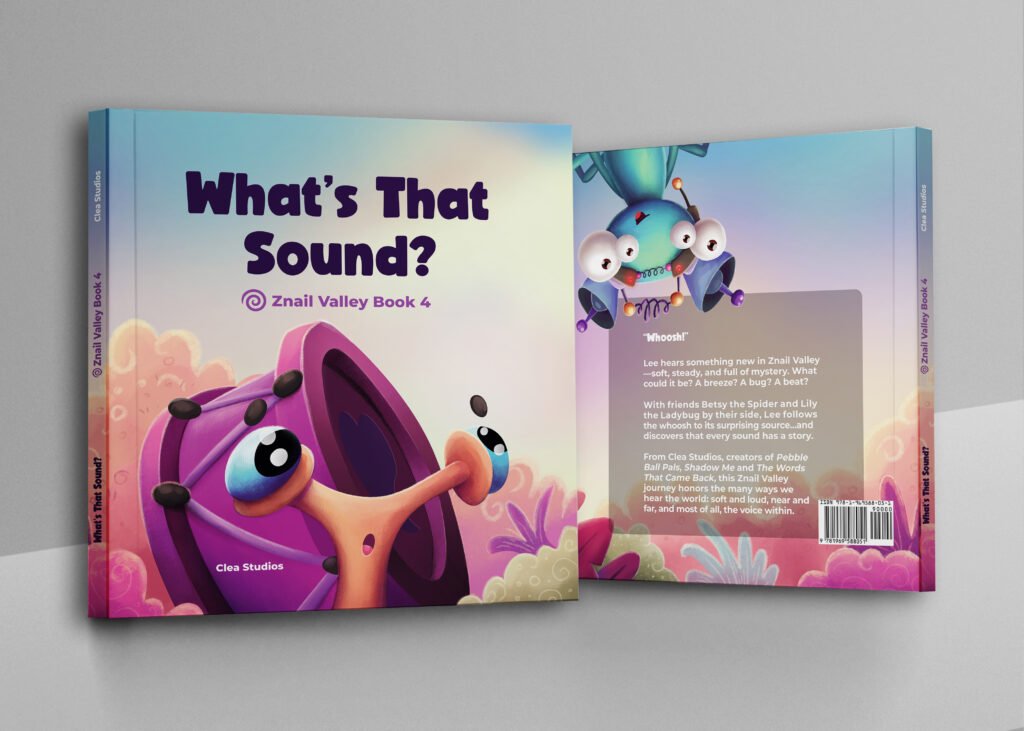
The Znail Valley connection
The mystery sound is closer than anyone thinks.
In What’s That Sound?, careful listening turns a funny mystery into a direct invitation for the child reading the story. The unexpected sound is the reader—their voice is not outside the adventure. It belongs inside it.
That reveal gives children a central role while opening questions about evidence, sound words and what it feels like when others notice and value your contribution.
Ask after reading
“What clues showed that the sound might be your voice? Which sound was most fun for your voice to make?”
Questions adults ask
Every voice can belong without sounding the same.
How can a child be helped to listen without turning it into a compliance demand?
Give listening a clear purpose, keep the interval short and offer options for how the child attends or responds. Listening may look like stillness, movement, drawing, pointing or asking for repetition.
What if a child guesses immediately?
Keep the guess and reopen the evidence: “That is one possibility. What did the sound itself tell you?” Curiosity can expand an answer without treating the first idea as a mistake.
Does valuing every voice mean every child must speak?
No. A child’s participation can be spoken, signed, drawn, acted, selected, shared through a partner or postponed. Belonging includes having a meaningful way to contribute and the agency to pass.
How can an adult show a child they were heard when the answer is still no?
Reflect the child’s meaning, invite correction and state the boundary clearly: “You wanted to stay longer. Leaving now is disappointing. We are still leaving at five.”
Sources and further reading
- Harvard Center on the Developing Child: Serve and Return
- NAEYC: Principles of Developmentally Appropriate Practice
- American Speech-Language-Hearing Association: Your Child’s Hearing
- CAST UDL Guidelines: Multiple Means of Engagement
Written by Aria de Clea for Znail Valley. Educational information for parents and educators; individualized developmental or medical concerns should be discussed with an appropriate qualified professional.
Small bugs · Big ideas
Listen long enough for the unexpected voice to enter.
Start with one sound, one pause and one genuine question. Careful attention tells a child: what you notice matters, and so does the voice you bring.