What’s That Sound?
A strange whoosh is moving through Znail Valley. Lee, Betsy, and Lily follow every rustle, plink, and pop—until the mystery leads beyond the page and all the way to the most important voice in the story. This playful picture book about listening carefully gives children ages 4–8 a mystery they can hear, describe and help solve.
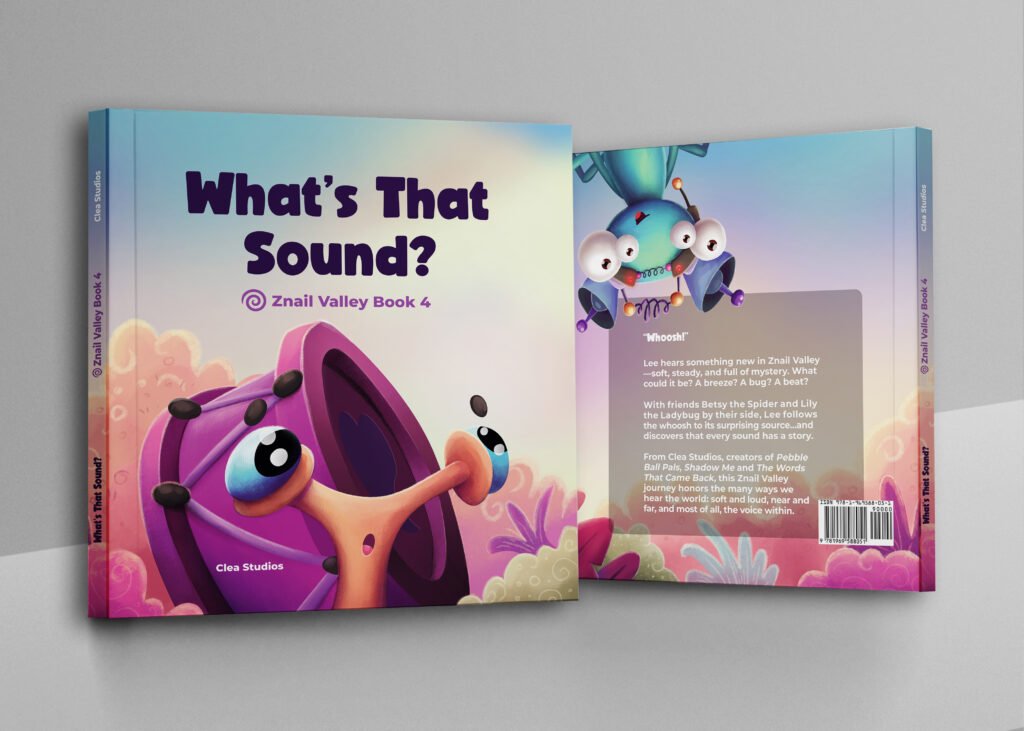
What’s That Sound?
A whoosh drifts over the hill, and Lee begins to listen. These opening pages start the sound trail before the mystery grows.


The story
The mystery is not only happening in front of the reader.
Lee hears a whoosh and sets off with Betsy and Lily to find its source. Each new sound becomes a clue, an experiment, and another reason to listen closely.
The search keeps turning outward—toward leaves, inventions, wings, and the valley itself. Then the story turns around and notices the child holding the book.
Lee, Betsy, and Lily’s listening trail
Follow a sound without rushing to name it.
A child-sized investigation sequence for reading, classrooms, or the next mysterious noise at home.
Hear it
Pause long enough to notice that a sound happened.
Describe it
Was it high, low, soft, sharp, steady, or bouncy?
Track it
Listen for direction, distance, repetition, and change.
Test an idea
Make a prediction, try it, and stay open to surprise.
Made for voices
Try the sounds. Then invent one only you would make.
There is no single correct performance. Whisper, stretch, clap, tap, hum, point, or listen.
Three pauses in the story
Let the reader become the sound detective.
These pauses preserve the mystery instead of turning the read-aloud into a quiz.
“What clues did the sound give us?”
Repeat the sound together or describe it without naming its source.
“Which idea would you test first?”
Ask what Lee, Betsy, or Lily might listen for next.
“Could the sound be somewhere else?”
Leave room for the possibility that the book is listening back.
For parents, teachers, and librarians
Make listening reciprocal.
The story’s strongest extension is not “listen to adults.” It is the experience of being listened to.
Follow their sound
If a child chooses one noise to repeat, join it before directing the next activity.
Notice many voices
Voices can be spoken, signed, drawn, tapped, moved, selected, or shared later.
Separate loud from important
A quiet contribution can matter just as much as the sound that fills the room.
Return the evidence
Say exactly what was heard: “Your idea changed where we looked next.”
Book details
What’s That Sound?
| Series | Znail Valley, Book 4 |
|---|---|
| Author | Aria de Clea |
| Publisher | Weeping Starlight Press |
| Published | October 20, 2025 |
| Length | 32 illustrated pages |
| Hardcover ISBN | 978-1-969588-05-1 |
| Audience | Ages 4–8 · Grades PreK–2 |
Questions grown-ups ask
About the book
What is What’s That Sound? about?
Lee, Betsy, and Lily follow a strange whoosh through Znail Valley. Their search explores sound, curiosity, and teamwork before revealing that the reader has a central role in the mystery.
What ages is the book for?
It is designed for ages 4–8 and works especially well as an interactive read-aloud for families, PreK–2 classrooms, and library storytimes.
Does the story teach sound science?
Yes. The adventure invites children to notice how sounds differ, where they may come from, how they travel, and how careful listening can help test an idea.
Is the reader part of the story?
Yes. The mystery is designed to turn toward the child, reinforcing that their voice matters and that reading can be something they help create.
Is it necessary to read the earlier books first?
No. What’s That Sound? is Book 4 in the Znail Valley series, but it can be read as a standalone adventure.
A Znail Valley listening adventure
The sound at the center of the story might be yours.
Follow the clues, make the noises, and discover what changes when a book listens back.