A Znail Valley field guide
What Are Glintkin?
Glintkin are the small, luminous creatures that make inspiration visible in Znail Valley. Their colors and silhouettes connect them to the characters whose ideas are beginning to glow, and their shifting presence shows that inspiration can be real before anyone can explain—or control—it.
The short answer
A glow with a clue inside.
In Glintkin Glow, Lee and their friends find little light-filled creatures above the moss. Betsy gives them a wonderfully serious-sounding classification: “Genus: Genius, Species: imaginapupa.” The name is playful. The story rule underneath it is precise: a Glintkin is a physical manifestation of inspiration.
That makes the creatures more than floating decoration. Their appearance carries information about who has been inspired, while their disappearing and returning gives the friends clues about the conditions in which a tentative idea can emerge.
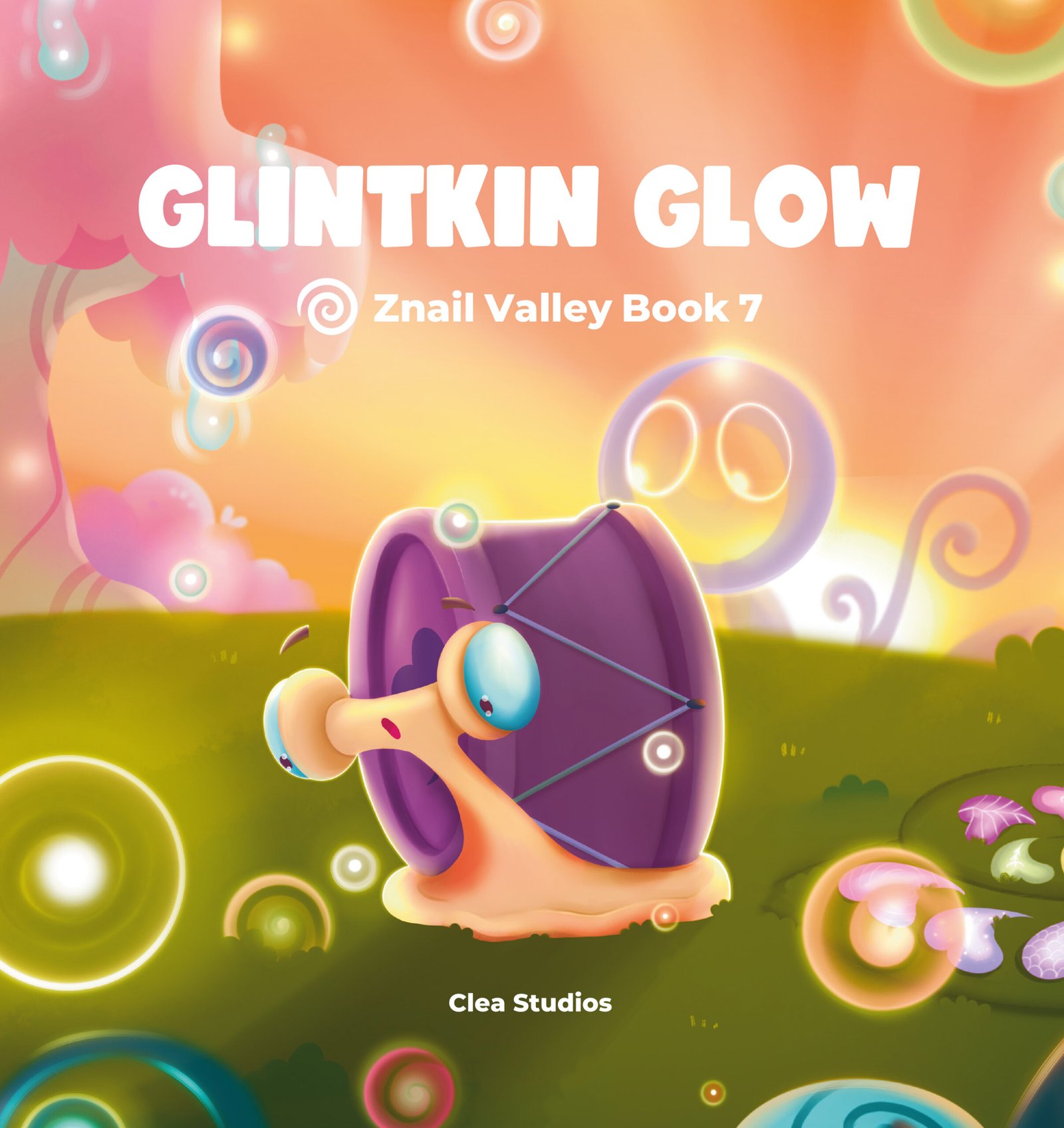
Where the Glintkin first glow
Meet them inside Glintkin Glow.
The Glintkin’s public story unfolds in Book 7, where Lee, Betsy, Flicker and Lily investigate what makes the strange little lights appear, disappear and return. Each attempt adds another clue about inspiration—and about the difference between supporting an idea and trying to control it.
Public-canon field guide
How to read a Glintkin.
The Glintkin do not arrive with labels. Znail Valley lets readers notice the visual rules the way Lee, Betsy, Flicker and Lily do: one shimmer, one silhouette and one surprising result at a time.
-
They make inspiration physical.
A beginning idea becomes something the characters—and the reader—can see. It may be bright and present even before it has a name, a plan or a finished form.
-
Color and silhouette point to the inspired character.
A Glintkin’s visual identity is tied to the character whose inspiration it represents. The glow is not a generic mood color; it is a story clue about where the spark has landed.
-
The number follows the number inspired.
When inspiration reaches more characters, the visible number of Glintkin corresponds to the number of characters inspired. It is a character count, not a score for whose idea is biggest or best.
-
Their capacity stays unreliable.
The story does not turn Glintkin into predictable batteries or inspiration dispensers. They can shimmer, retreat, vanish and return as conditions change. Their exact limits remain unknown.
Evidence from Book 7
The friends learn by watching what happens.
The Glintkin rules are not delivered as a lecture. They emerge through the friends’ attempts, mistakes and observations in the finished story.
-
First: a shimmer above the moss.
After the Seeds of Creativity have been planted, Lee and their friends notice small light bubbles. Wonder comes before explanation.
-
Then: brighter is not always better.
Flicker adds more light. The Glintkin disappear. An effort meant to help becomes useful information.
-
Next: structure can become a squeeze.
Betsy tries thread and support. The Glintkin disappear again. The friends revise what “help” might need to look like.
-
Finally: change the space, not the spark.
The friends stop trying to trap or direct the creatures. Quiet shelters, softer conditions and protection give the glow room to return on its own.
The grown-up layer
Creative confidence can begin before confidence looks confident.
For a child, Glintkin are mysterious creatures that go fwip. For an adult, they offer a concrete way to recognize an early idea: small, unfinished, sensitive to its surroundings and still worth protecting.
The story does not ask adults to manufacture inspiration. It asks a more useful question: What in the environment is helping this idea stay visible—and what is making it retreat?
The National Association for the Education of Young Children identifies play as central to learning and to children’s symbolic thinking, imagination and problem-solving. That is why the invitation below stays playful, open-ended and free of a required “right” result.
An idea can be real while it is still quiet, strange, changing—or difficult to explain.
Try it together · Ages 4–8 / PreK–Grade 2
Make an idea shelter.
Choose an idea that is spoken, drawn, built, acted, hummed—or still only imagined. Then protect the conditions around it instead of requiring it to perform.
-
Notice
Ask, “Is there a tiny idea here?” A point, gesture, sound or “maybe” can count.
-
Choose
Let the child pick one support: quiet, time, materials, movement, company or privacy.
-
Shelter
Give the idea a page, box, folder, voice note, block of time or small physical space.
-
Return
Look again later. “Still forming,” “changed” and “gone for now” are all complete answers.
Glintkin questions
A few things readers ask.
What does “Glintkin” mean?
Glintkin are Znail Valley creatures that physically manifest inspiration. Their glow, color, silhouette and number make an inner spark visible within the story world.
Are Glintkin ideas, or creatures?
They are both story-world creatures and a visual metaphor for inspiration. The characters observe them as living, responsive beings, while readers can also recognize what their behavior says about tentative ideas.
Why do the Glintkin disappear?
In Glintkin Glow, glare, wrapping thread and loud rushing overwhelm the creatures. Their disappearance gives the friends clues that protection and control are not the same thing.
Which book introduces the Glintkin?
Their central published story is Glintkin Glow, Book 7 in the Znail Valley picture-book series by Aria de Clea, published by Weeping Starlight Press.
Keep exploring
Follow the glow into the story.
Meet Lee, Betsy, Flicker and Lily as they test ideas, notice the results and make room for the Glintkin to return.
Znail Valley · Created by Aria de Clea · Published by Weeping Starlight Press · A Clea Studios story world